Ariella Carmell – A unique voice and creative vision make her a standout in contemporary screenwriting and storytelling.

“Writers are often the unsung architects behind every production, quietly shaping worlds and characters that only come alive when actors step onto the stage or screen.”
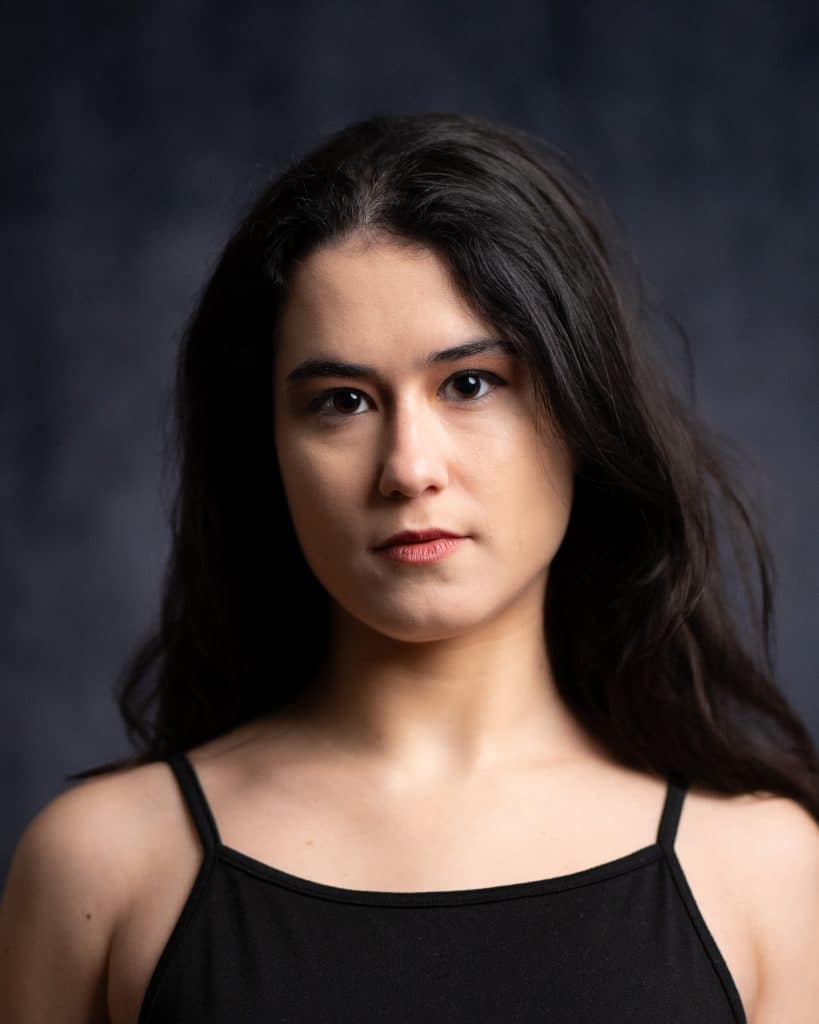
Ariella Carmell
Writers are often the unsung architects behind every production, quietly shaping worlds and characters that only come alive when actors step onto the stage or screen. It’s a perspective that resonates with me—having written my own book, Dreamstones, back in 2011, I know firsthand how creativity can simmer late into the night, fuelled by unconventional hours and a relentless drive for perfection. The process is messy, magical, and sometimes solitary, but it’s always deeply rewarding.
Ariella Carmell—her name is practically shorthand for boundary-pushing playwriting and screenwriting, though that’s just the tip of the iceberg when it comes to her talents. It’s impossible not to focus on her writing, given the sheer impact she’s had on the entertainment world, but there’s so much more to her creative journey.
Magazine Interview
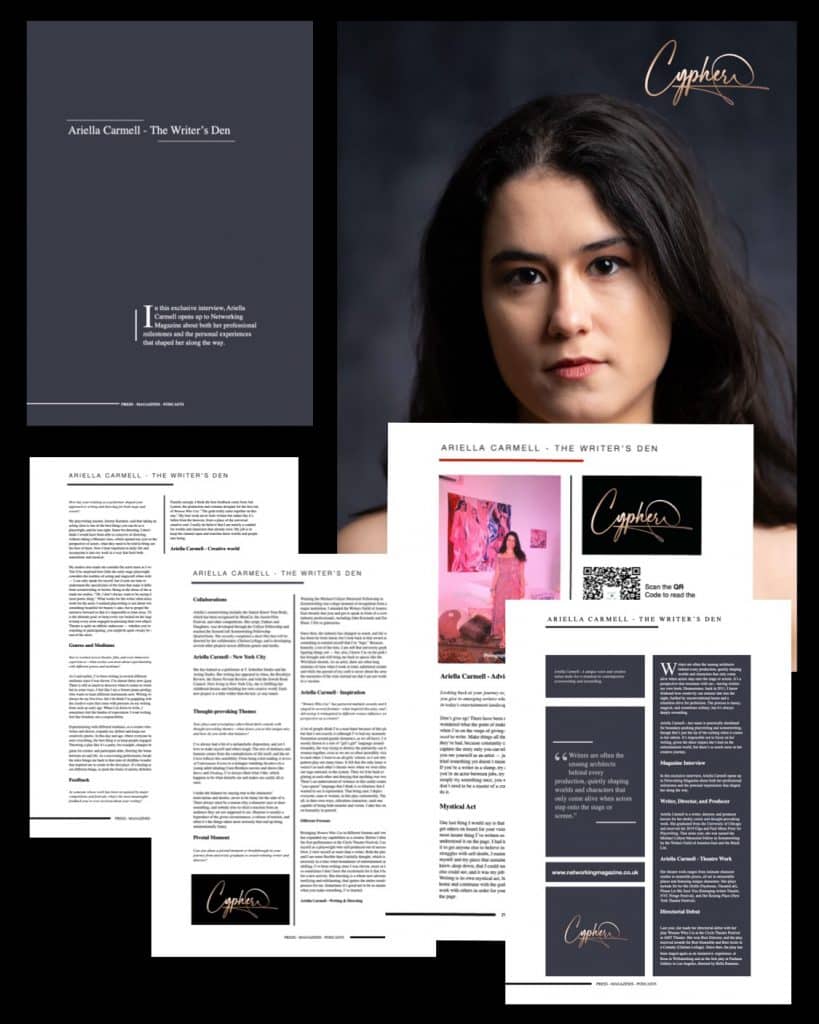
In this exclusive interview, Ariella Carmell opens up to Networking Magazine about both her professional milestones and the personal experiences that shaped her along the way.
Writer, Director, and Producer
Ariella Carmell is a writer, director, and producer known for her darkly comic and thought-provoking work. She graduated from the University of Chicago and received the 2019 Olga and Paul Menn Prize for Playwriting. That same year, she was named the Michael Collyer Memorial Fellow in Screenwriting by the Writers Guild of America East and the Black List.
Ariella Carmell – Theatre Work
Her theatre work ranges from intimate character studies to ensemble pieces, all set in memorable places and featuring unique characters. Her plays include Sit for Me (SoHo Playhouse, TheaterLab), Please Let Me Save You (Emerging Artists Theatre, NYC Fringe Festival), and Her Resting Place (New York Theater Festival).
Directorial Debut
Last year, she made her directorial debut with her play Women Who Cut at the Circle Theatre Festival at AMT Theatre. She won Best Director, and the play received awards for Best Ensemble and Best Actor in a Comedy (Chelsea LeSage). Since then, the play has been staged again as an immersive experience at Rosa in Williamsburg and as the first play at Pauhaus Gallery in Los Angeles, directed by Bella Balsamo.
Collaborations
Ariella’s screenwriting includes the feature Know Your Body, which has been recognised by BlueCat, the Austin Film Festival, and other competitions. Her script, Fathers and Daughters, was developed through the Collyer Fellowship and reached the ScreenCraft Screenwriting Fellowship Quarterfinals. She recently completed a short film that will be directed by her collaborator, Chelsea LeSage, and is developing several other projects across different genres and media.
Ariella Carmell – New York City
She has trained as a performer at T. Schreiber Studio and the Acting Studio. Her writing has appeared in Alma, the Brooklyn Review, the Sierra Nevada Review, and with the Jewish Book Council. Now living in New York City, she is fulfilling her childhood dreams and building her own creative world. Each new project is a little wilder than the last, so stay tuned.
Thought-provoking Themes
Your plays and screenplays often blend dark comedy with thought-provoking themes—what draws you to this unique mix, and how do you strike that balance?
I’ve always had a bit of a melancholic disposition, and yet I love to make myself and others laugh. The mix of darkness and humour comes from the contradictions of life itself, and the art I love reflects this sensibility. From being a kid reading A Series of Unfortunate Events to a teenager watching Heathers to a young adult inhaling Coen Brothers movies and shows like Barry and Fleabag, I’ve always liked what I like, which happens to be what disturbs me and makes me cackle all at once.
I strike the balance by staying true to the characters’ motivations and desires, never to be funny for the sake of it. There always must be a reason why a character says or does something, and nobody tries to elicit a reaction from an audience they are not supposed to see. Humour is usually a byproduct of the given circumstances, a release of tension, and often it’s the things taken most seriously that end up being unintentionally funny.
Pivotal Moment
Can you share a pivotal moment or breakthrough in your journey from university graduate to award-winning writer and director?
Winning the Michael Collyer Memorial Fellowship in Screenwriting was a huge moment of recognition from a major institution. I attended the Writers Guild of America East Awards that year and got to speak in front of a crowd of industry professionals, including John Krasinski and Emily Blunt. I felt so glamorous.
Since then, the industry has changed so much, and the road has been far from linear, but I look back at that award as something to remind myself that I’m “legit.” Because, honestly, a lot of the time, I am still that university graduate figuring things out — but, also, I know I’m on the path that has brought and will bring me back to spaces like the WGAEast Awards. As an artist, there are often long stretches of time when I work in total, unfettered isolation, and while the pursuit of my craft is never about the awards, the memories of the wins remind me that I am not working in a vacuum.
Ariella Carmell – Inspiration
“Women Who Cut” has garnered multiple awards and been staged in several formats—what inspired this play, and how did seeing it reimagined in different venues influence your perspective as a creator?
A lot of people think I’m a man-hater because of this play, but that’s not exactly it (although I’ve had my moments of frustration around gender dynamics, as we all have). I was mostly drawn to a sort of “girl’s girl” language around misandry, the way trying to destroy the patriarchy can bring women together, even as we are so often incredibly vicious to each other. I went to an all-girls’ school, so I saw this pattern play out many times. It felt that the only times we weren’t at each other’s throats were when we were directing our rage outward, to the system. Then we’d be back to glaring at each other and denying that anything was wrong. There’s an undercurrent of violence in this candy-coated “yass queen” language that I think is so hilarious that I wanted to see it represented. That being said, I depict everyone, man or woman, in this play cartoonishly. They are all, in their own ways, ridiculous characters, each one capable of being both monster and victim. I take this stance on humanity in general.
Different Formats
Restaging Women Who Cut in different formats and venues has expanded my capabilities as a creator. Before I directed the first performance at the Circle Theatre Festival, I saw myself as a playwright who self-produced out of necessity. Now, I view myself as more than a writer. Both the piece and I are more flexible than I initially thought, which is a necessity in a time when boundaries of entertainment are shifting. I’ve been writing since I was eleven, more or less, so sometimes I don’t have the excitement for it that I have for a new activity. But directing is a whole new adventure, terrifying and exhilarating, that ignites the entire creative process for me. Sometimes it’s good not to be so masterful when you make something, I’ve learned.
Ariella Carmell – Writing & Directing
How has your training as a performer shaped your approach to writing and directing for both stage and screen?
My playwriting teacher, Jeremy Kareken, said that taking an acting class is one of the best things you can do as a playwright, and he was right. Same for directing. I don’t think I would have been able to conceive of directing without taking a Meisner class, which opened my eyes to the perspective of actors, what they need to be told to bring out the best of them. Now I hear repetition in daily life and incorporate it into my work in a way that feels both naturalistic and musical.
My studies also made me consider the actor more as I write. You’d be surprised how little the early-stage playwright considers the realities of acting and stagecraft when writing — I can only speak for myself, but it took me time to understand the specificities of the form that make it different from screenwriting or fiction. Being in the shoes of the actor made me realise, “Oh, I don’t always want to be saying the most poetic thing.” What works for the writer often doesn’t work for the actor. I realised playwriting is not about writing something beautiful for beauty’s sake, but to propel the narrative forward so that it’s impossible to look away. That is the ultimate goal: to keep every eye locked on the stage, to keep every actor engaged in pursuing their own objective. Theatre is quite an athletic endeavour — whether you’re watching or participating, you might be quite sweaty by the end of the show.
Genres and Mediums
You’ve worked across theatre, film, and even immersive experiences—what excites you most about experimenting with different genres and mediums?
As I said earlier, I’ve been writing in several different mediums since I was eleven. I’m almost thirty now (gasp!). There is still so much to discover when it comes to writing, but in some ways, I feel like I am a former piano prodigy who wants to learn different instruments now. Writing will always be my first love, but I do think I’m grappling with the creative scars that come with pressure on my writing from such an early age. When I sit down to write, I sometimes feel the burden of expectation. I want writing to feel like freedom, not a responsibility.
Experimenting with different mediums, as a creator who writes and directs, expands my skillset and keeps me creatively plastic. In this day and age, where everyone has seen everything, the best thing is to keep people engaged. Throwing a play like it’s a party, for example, changes the game for creator and participant alike, blurring the boundary between art and life. As a recovering perfectionist, breaking the rules brings me back to that state of childlike wonder that inspired me to create in the first place. It’s healing to try out different things, to push the limits of artistic definitions.
Feedback
As someone whose work has been recognised by major competitions and festivals, what’s the most meaningful feedback you’ve ever received about your writing?
Funnily enough, I think the best feedback came from Adi Lynton, the production and costume designer for the first run of Women Who Cut: “The gods really came together on this one.” My best work never feels written but rather like it’s fallen from the heavens, from a place of the universal creative soul. I really do believe that I am merely a conduit for worlds and characters that already exist. My job is to keep the channel open and translate these worlds and people into being.
Ariella Carmell – Creative world
You mention building your own creative world—what does that world look like, and how do you stay inspired to keep pushing its boundaries?
With each production, my web of collaborators grows. I love connecting with fellow artists and working with them multiple times, and seeing the way they connect with each other as well. To see how the girls of Women Who Cut kept working on different projects together after the show ended warmed my heart. It makes me feel like each production lives on beyond its run, that there’s a greater purpose to the ephemeral nature of a show.
I want to keep working with former collaborators in different capacities and different roles, as well as expand my network of possibilities. There’s a staggering amount of talent out there, and like a Pokémon master, I’m going to catch ’em all. That’s the satisfaction of working in production and not only writing: the whole venture becomes about something bigger than myself and my words.
Artistic Growth
Collaboration seems central to your process; can you talk about a partnership or project that had a major impact on your artistic growth?
That’s a hard one — I’ve been lucky to have so many talented collaborators: Andie Lerner, Meredith Ginsburg, Talya Dayan, and Emma Tadmor, to name a few. I’ve learned so much from all of them, and each, in their own way, has impacted my work.
Working with Chelsea LeSage on both Sit for Me and Women Who Cut has been so important to me. She’s the real deal, a truly consummate actor, not to mention such a lovely and calming presence. When she auditioned for Sit for Me, the air in the room changed. She was absolutely amazing in that role, and a pleasure to work with, but her performance as Ava in Women Who Cut really showcased her brilliance. Never afraid to try anything, she was absolutely deranged in that role, and I loved every second of it. Off-stage, though, she could not be more calming as I navigated my first time directing. It meant so much to me that I won Best Director and she won Best Actor, a testament to the power of our collaboration, because we both brought out the best in each other. I will work with her anytime.
Ariella Carmell – Advice
Looking back at your journey so far, what advice would you give to emerging writers who want to make their mark in today’s entertainment landscape?
Don’t give up! There have been many, many times when I wondered what the point of making art is, but it’s always when I’m on the verge of giving up that I write the story I need to write. Make things all the time, especially if they’re bad, because constantly creating will prime you to capture the story only you can tell. Don’t be rigid in how you see yourself as an artist — just because you haven’t tried something yet doesn’t mean you shouldn’t pursue it. If you’re a writer in a slump, try acting or directing. If you’re an actor between jobs, try writing. Even if you simply try something once, you will learn so much. You don’t need to be a master of a craft to have permission to do it.
Mystical Act
One last thing I would say is that you need to be the one to get others on board for your vision. Women Who Cut is the most insane thing I’ve written so far, and not everyone understood it on the page. I had to be the one to believe in it to get anyone else to believe in it. Even though I had my struggles with self-doubt, I maintained confidence in myself and my piece that sustained the whole production. I knew, deep down, that I could see something that no one else could see, and it was my job to get them to see it. Writing is its own mystical act, but it’s not enough to sit at home and commune with the gods on your own: you must work with others in order for your words to exist beyond the page.
Listen to our talk show
Contact the magazine.
Listen to our talk show on YouTube.